NAPDS Home

About NAPDS

PDS National Conference

Exemplary PDS Achievement Award

Nine Essentials

Elections

Membership

Publications

*NEW
NAPDS in the News

Related PDS Events Links

Related PDS Resources Links
NAPDS Store

Contact Us


Follow Us On


Press Release
National Association for Professional Development Schools
July 20, 2011

The National Association for Professional Development Schools (NAPDS) recently selected its next team of editors for its flagship journal, School-University Partnerships (SUP). NAPDS is the only national organization in the United States dedicated to promoting school/university partnerships in support of teacher education, P-12 student achievement, educational research, and professional development for pre- and in-service school- and university-based educators and teacher educators. School-University Partnerships is the only peer-reviewed journal focused on research reports related to Professional Development Schools. The current editors of the journal are Pam Campbell (University of Nevada-Las Vegas, NV) and Eva White (Clark County School District, NV). Beginning with the Spring 2012 issue of the journal, the new editors will consist of a team from three PDS partnerships, in Virginia, Ohio, and Texas. The team will include Kristien Zenkov (Senior Editor, George Mason University, VA), Athene Bell (Editor, Manassas City Schools, VA), Diane Corrigan (Editor, Cleveland State University, OH), Jim Harmon (Editor, Euclid High School, OH), Ron Beebe (Editor, University of Houston-Downtown, TX), and Martina Ramos-Rey (Editor, North Shore Elementary School, TX). Submissions and inquiries to School-University Partnerships can be emailed to supjournal@gmail.com.


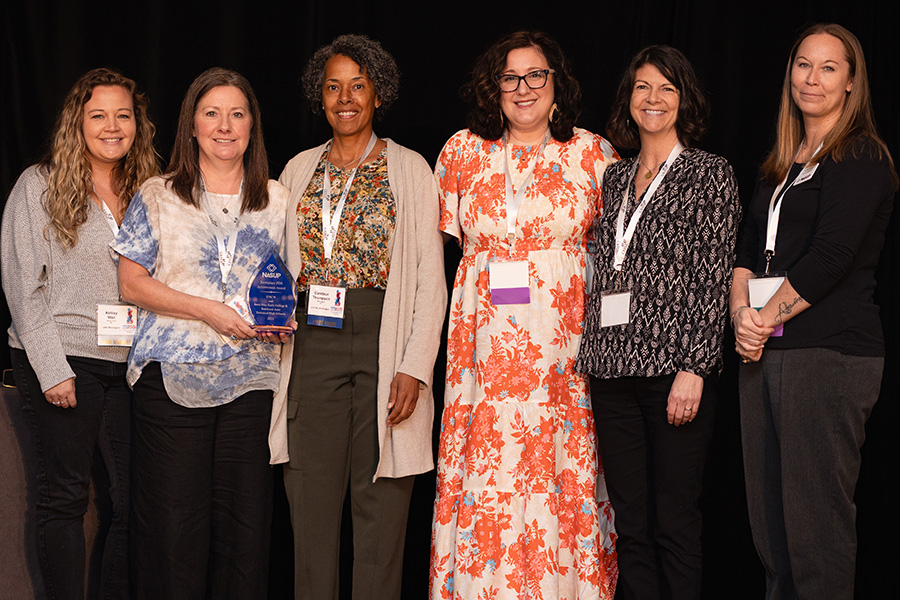
Congratulations to the 2011 Recipients of the
Exemplary PDS Achievement Award

Buffalo State College, School of Education, Department of Elementary Education and Reading Professional Development School Consortium
Cleveland State University Master of Urban Secondary Teaching and Cleveland School of Science and Medicine
Kansas State University College of Education PDS Partnership
Rice Creek Elementary School and the University of South Carolina PDS
 
Salisbury University and Worcester County Public Schools Snow Hill Elementary/Worcester Elementary PDS Cluster


NAPDS Response to Education Week Letter
Regarding Teacher Preparation

As an advocate organization for professional development school partnerships, the NAPDS felt compelled to respond to a letter to the editor of Education Week. In our view, Dr. Wheatley's argument for less collaboration among college and university professors and P - 12 teachers and administrators results in weakening teacher preparation programs. In cases such as this, the NAPDS is obligated to speak out on behalf of its membership. Please find both Dr. Wheatley's letter and the NAPDS response below. If you are a subscriber to Education Week, please add your viewpoints on their site or by posting them on the NAPDS facebook page.

From Education Week [American Education's Newspaper of Record]
Wednesday, December 8, 2010, Volume 30, Issue 14, p. 26.
See http://www.edweek.org/ew/articles/2010/12/08/14letter1.h30.html?r=1737546376

More Preservice Teaching in Schools Not Effective

To the Editor:

Your article "Momentum Builds to Restructure Teacher Education"
(Education Week, Nov. 17, 2010 - see
http://www.edweek.org/ew/articles/2010/11/17/13teacherprep.h30.html) indicates that the trend in teacher education is greater emphasis on field experiences, including more time in school classrooms working with "experienced" teachers. My 50 years of experience as a supervising teacher, university student-teacher supervisor, and director of mathematics education programs at two major universities does not support this proposal.

In many cases, working teachers were not competent to provide advice by example to prospective teachers. In fact, what usually occurs is that the preservice teacher is indoctrinated in the "old school" way of doing things.

University educators are generally informed about new practices that are more effective.

Prospective teachers leave our research- and theory-based classes eager to implement these proven methods. But when they get to the school, they quickly get the message: "This is how we do things here."

Traditional textbooks, for example, are based on a model for a previous generation and never evaluated, often written by editors based on market research rather than the authors whose names are on the texts. (I have experienced this practice working with five major publishers.) Further, having conducted staff development with more than 100 school systems, I rarely see any change in practice among high school teachers, while elementary and middle school teachers have been open to new ideas. Thus, giving in-service teachers more influence over preservice teachers just perpetuates the failed practices in place.

Preservice teachers must be guided by individuals who are well informed about new approaches such as those exemplified by the National Science Foundation-funded curricula being used in a few schools. Giving more of a role to teachers who are not up to date will not be effective.

Grayson H. Wheatley,
Bethany Beach, Delaware

NAPDS Response to Dr. Wheatley's Letter:

Professors Are Not the Only Ones Who Create Innovations

Dr.  Grayson Wheatley has concluded that a major recommendation from the recent Blue Ribbon Panel convened by the National Council for Accreditation of Teacher Education to make clinical practice the major lynchpin of high-quality and highly-effective teacher education programs is ill-advised [Education Week, December 8, Volume 30, Issue 4, p. 26].  Professor Wheatley contends that teacher candidates who might be introduced to new ideas from higher education professionals are then placed into secondary schools where outdated instructional rules and practices force teacher candidates to comply with instructional routines that are neither exemplary or innovative.

Unfortunately, Professor Wheatley is completely ignoring a body of information that flies in the face of his conclusions.  The National Association of Professional Schools (NAPDS) comprises partnerships between schools of education and P-12 schools in which faculty from both settings collaborate to bring best practices to the preparation of prospective teachers.   A policy platform of NAPDS is that partnerships between higher education and P-12 faculty lead to true innovation and that innovative ideas come from both faculty in P-12 schools as well as those from higher education. NAPDS has chronicled more than 200 professional practices in secondary school professional development schools that highlight the fact that innovative practices can and are indeed being wrought through these partnerships. 

In education, it is all right to look at the past as long as you do not stare.  It is time to get past the outdated notions that educational innovation can only occur in colleges and universities. Our P-12 students deserve to have teachers whose preparation permits them to be highly effective.  That can only happen if such preparation includes meaningful collaborations between professors and classroom teachers.  NCATE and NAPDS know full well that through these partnerships, innovations in instructional practices are and will continue to be realized.

Les Sternberg, Dean
College of Education
University of South Carolina


RETURN TO TOP